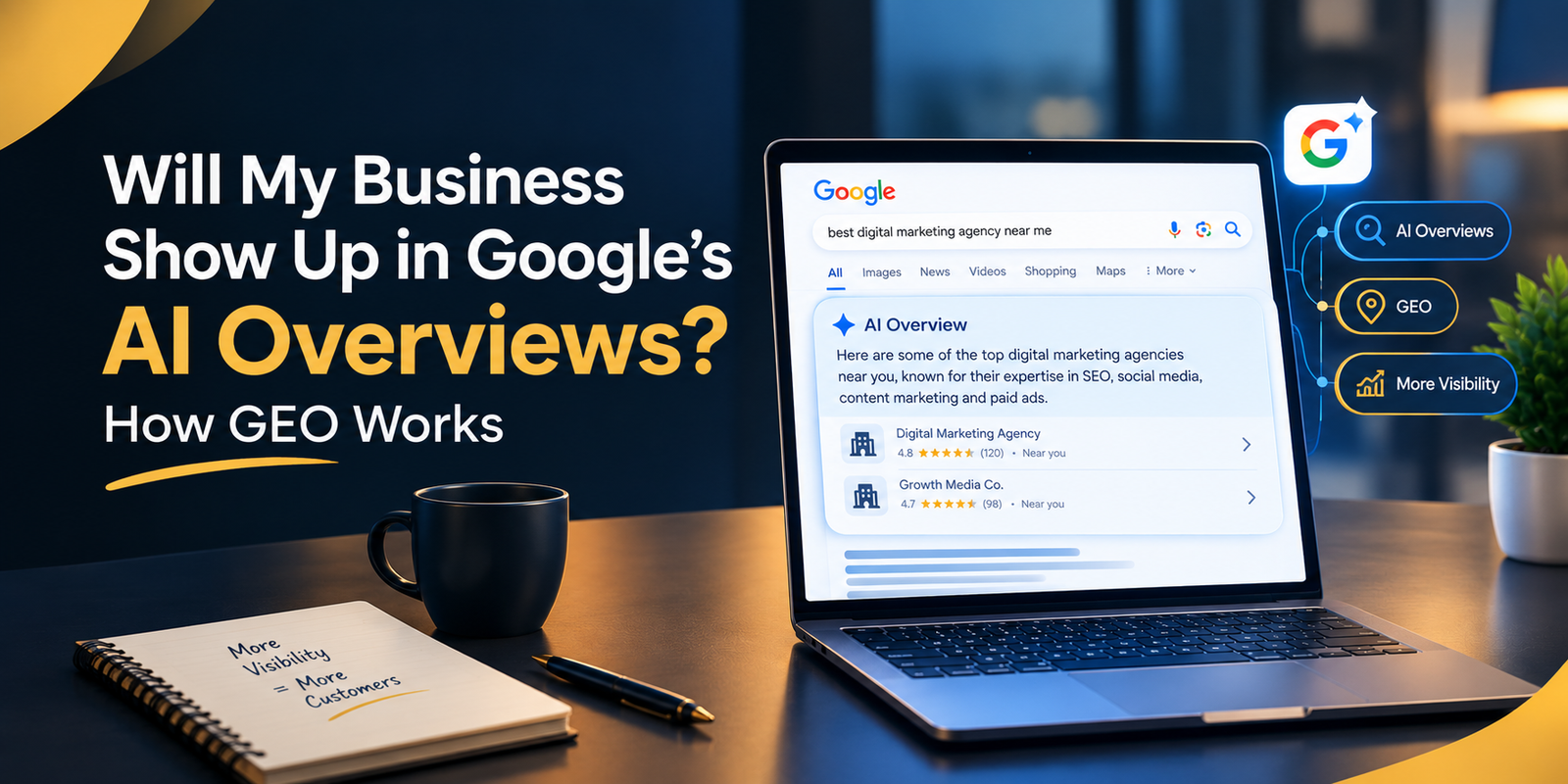
If you've searched anything on Google recently, you've probably noticed a summary box appearing right at the top of the results, before the usual list of blue links. This is Google's AI Overview, and it's changing how people find information, and how businesses need to think about visibility online. If you've spent time and money getting your website to rank well, you might be wondering whether all that effort still counts, or if there's a whole new game to learn. This guide breaks down what GEO is, how AI Overviews actually pick their sources, and what small businesses can realistically do about it.
Quick Answer
GEO, or Generative Engine Optimization, is the practice of structuring your content so AI tools like Google's AI Overviews can easily understand, extract and use it when generating answers. Small businesses absolutely can show up in AI Overviews, especially for specific, local queries, but it requires content that answers questions clearly and is backed by real expertise and trust signals.
What Are Google's AI Overviews?
AI Overviews are AI-generated summaries that appear at the top of Google search results for many queries. Instead of making you click through multiple websites, Google pulls together information from several sources and presents a direct answer right there on the results page. For businesses, this means a shrinking number of clicks going to individual websites, but also a new opportunity, since being featured inside that summary puts your business directly in front of the searcher.
What Is GEO (Generative Engine Optimization)?
GEO is essentially SEO's newer cousin. Where traditional SEO focuses on ranking your page in the list of search results, GEO focuses on getting your content chosen as a source when an AI system generates its answer. Both are about visibility, but the mechanics of how you earn that visibility are a little different.
How GEO Is Different from Traditional SEO
Factor
Traditional SEO
GEO
Goal
Rank high in search results list
Get pulled into the AI-generated answer
Content style
Keyword-optimised pages
Clear, direct, question-answering content
Format that helps
Headings, backlinks
Structured data, FAQs, tables, clear answers
Authority factor
Backlinks and domain age
E-E-A-T signals and topical depth
Success signal
Click-through rate, rankings
Being cited or summarised by AI
The two aren't separate strategies, they overlap heavily. Good SEO fundamentals are still the foundation, GEO just adds an extra layer of structure and clarity on top.
How Do AI Overviews Pick Their Sources?
Google's AI Overviews don't crawl the entire web fresh for every single search. Instead, they draw from content Google has already indexed and considers trustworthy, relevant and well-organised. When a query comes in, the system looks for pages that answer that specific question clearly, then summarises and cites from a handful of the best matches.
Why Ranking #1 Doesn't Guarantee an AI Overview Spot
This is where a lot of businesses get confused. Ranking first in traditional search results doesn't automatically mean you'll be featured in the AI Overview. Sometimes a page ranking fifth or sixth gets pulled in instead, simply because it answers the exact question more directly and cleanly than the page sitting at the top. This is actually good news, since it means smaller, more specific and well-written content can outperform bigger, more generic pages from larger competitors.
What Increases Your Chances of Being Featured
Answering Questions Clearly and Early
AI systems favour content that gets to the point fast. If your blog buries the actual answer three paragraphs down, an AI system is less likely to extract it cleanly. Leading with a short, direct answer, the way we now open our own blogs with a "Quick Answer" section, gives AI something easy to pull from.
Structuring Content for AI to Read
Proper headings, bullet points, tables and FAQ sections all make your content easier to scan and extract, both for readers and for AI systems. Messy, unstructured walls of text are much harder to summarise accurately.
Building Topical Authority
Publishing consistently well-organised content around one topic, rather than scattered posts on unrelated subjects, signals to both Google and AI systems that you genuinely know the subject. Over time, this builds trust that helps across your entire site, not just one page.
Adding Original Data or Insights
Generic, rehashed content that just repeats what's already out there doesn't stand out. AI systems, like human readers, respond better to original insights, real numbers, case examples or a genuinely useful angle that isn't found everywhere else.
Strengthening E-E-A-T Signals
E-E-A-T stands for Experience, Expertise, Authoritativeness and Trustworthiness. It's a framework Google uses to judge content quality, and it matters just as much for GEO as it does for traditional SEO.
Experience
This means showing you've actually done the thing you're writing about, not just researched it. First-hand examples, case studies or real results carry more weight than purely theoretical advice.
Expertise
This is about demonstrating real knowledge of the subject, using accurate information, proper terminology, and depth that goes beyond surface-level content.
Authoritativeness
This is built through recognition from others, such as being mentioned or linked to by other credible sources, having a strong author profile, or being known within your industry.
Trustworthiness
This covers the basics that make a site feel credible, like clear contact information, transparent business details, secure browsing, and accurate, well-sourced content.
Can a Small Business Realistically Show Up in AI Overviews?
Yes, and often more easily than you'd expect. AI Overviews tend to favour genuinely useful, well-structured answers over sheer brand size alone. A small business that writes honest, specific, well-organised content about its own industry or local area has a real shot at being featured, especially for local and niche queries where big brands haven't bothered to write detailed content.
Common GEO Mistakes to Avoid
Mistake
Why It Hurts
Burying the answer deep in the content
AI can't easily extract it
Writing vague, generic content
Doesn't stand out as a unique source
Ignoring structure (headings, tables)
Harder for AI to parse and summarise
No author or business credibility info
Weakens trust signals
Copying competitor content
Adds no original value to be cited for
How to Start Optimising for GEO Today
Conclusion
GEO isn't a replacement for SEO, it's an extension of it. The businesses that show up in AI Overviews are usually the ones already doing good SEO fundamentals, just with an added focus on clarity, structure and genuine expertise. For small businesses, this is a real opportunity, since specific, honest, well-organised content can now compete directly with much bigger names, sometimes even beating them to the answer box.